

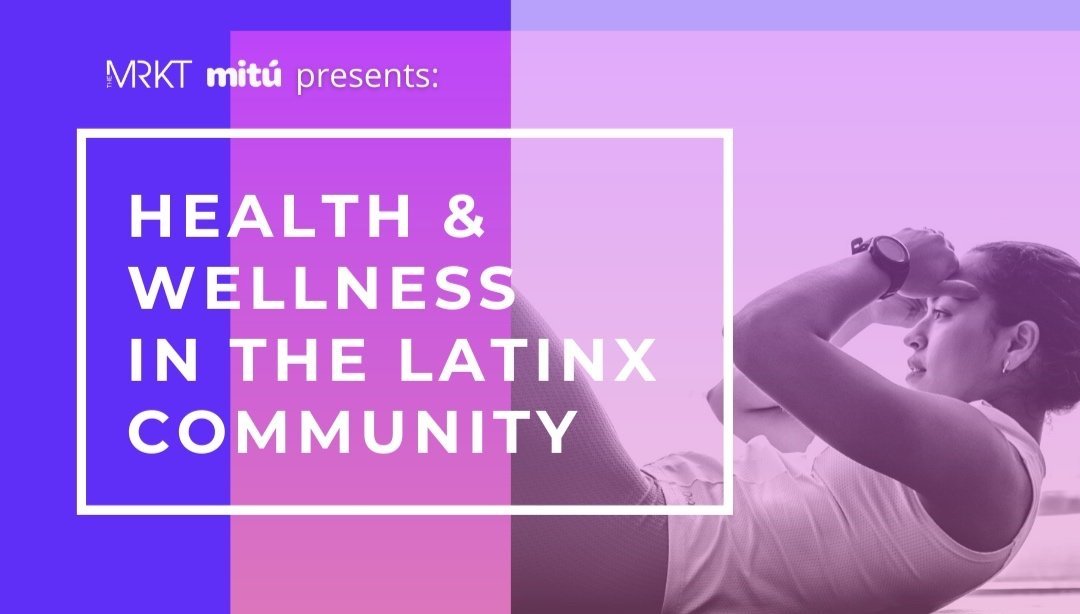
LOS ANGELES, CA – November 18, 2021 – Mitú And The MRKT Release the First of a Series of Studies on the Current State of the U.S. Latino Community Titled The mitú InTell Series, the study aims to reveal the current state of the Hispanic community post-pandemic.

Leading Latino digital media company mitú, in partnership with premier multicultural marketing and communications agency The MRKT, released today the first of a series of studies titled The mitú InTell Series. The studies aim to gain and socialize insights on the current state of the U.S. Hispanic community while digging deeper into their motivations and behaviors behind topics ranging from health and wellness to finance, sports, food, commerce, and travel.
Mitú InTell: Health & Wellness in the Latinx Community
“As a digital media brand that has stood for Latinx representation for 10 years, mitú has conversations with millions of Latinos daily. This interaction and our editorial process allows us to gather signals and real-world concerns from our audience to develop insights not only on what our community is thinking, but also why – and to do so while the topics are still actionable and timely,” said President of mitú, Stephen Brooks.“Ultimately we feel a responsibility to not only share these insights, but to give a voice to our audience.”
Both mitú and The MRKT are inherently able to provide insights into the state of the U.S. Hispanic population both from a macro, public perspective and at an interpersonal scale, allowing them to uncover nuances and evaluate the community from a unique point of view not seen before.
“As a leading multicultural marketing and communications agency, our team lives and breathes the experiences that permeate the cultural zeitgeist within our community, making the issues that affect the U.S. Hispanic community incredibly evident to us. It is with that real-world and professional experience that we help create these studies which we hope enable other entities and organizations to identify the most current needs of the U.S. Latino population and bring us closer to a future where our community is fully seen and heard.” said President of The MRKT, Marcos Barron.
This first online quantitative study – conducted by a third party, HyperFocus ROI, with a sample size of 1,000 U.S. Hispanics – consisted of evaluating participants for their various attitudes, perceptions and behaviors across a number of demographic segments relative to the broader topic of health & wellness. Four key areas under this topic – medical, mental health, fitness + exercise and nutrition – were evaluated across key audience segments broken out by age, income, gender, and U.S. vs. non U.S. born.
While specific insights relative to each of these four areas were uncovered across the various audience segments, mental health emerged as the most common denominator, garnering the highest overall importance ratings when compared with the other three subcategories, with 65% of all respondents rating mental health as very important. Notably, mental health has declined across all segments of the U.S. Latino population vs. two years ago.
Additional key findings include:
- U.S. born Latinos are reporting health issues that affect multiple generations at nearly twice the rate as non U.S. born Latinos.
- 37% of the Latinos surveyed report that the #1 reason they don’t have a primary care physician is their financial situation, with non U.S. born Latinos expressing this as a barrier with even more frequency at a rate of 46%.
- Latinos in the lowest income bracket (earning under $49K) are rating all of the health subcategories (medical, mental health, fitness + exercise, nutrition) as being somewhat/not at all important to them. However, there are some key barriers and reasons that surfaced on why they may not be placing importance on their health when compared to the other groups.
- Out of the four subcategories, Latinos aren’t placing as much importance on fitness + exercise even though their reported habits are demonstrating that they are exercising at higher rates when compared to two years ago, with 45% stating that they are exercising more often.
For more key insights and to read the full study, visit: http://mituintell.mitunetwork.com or see below.